
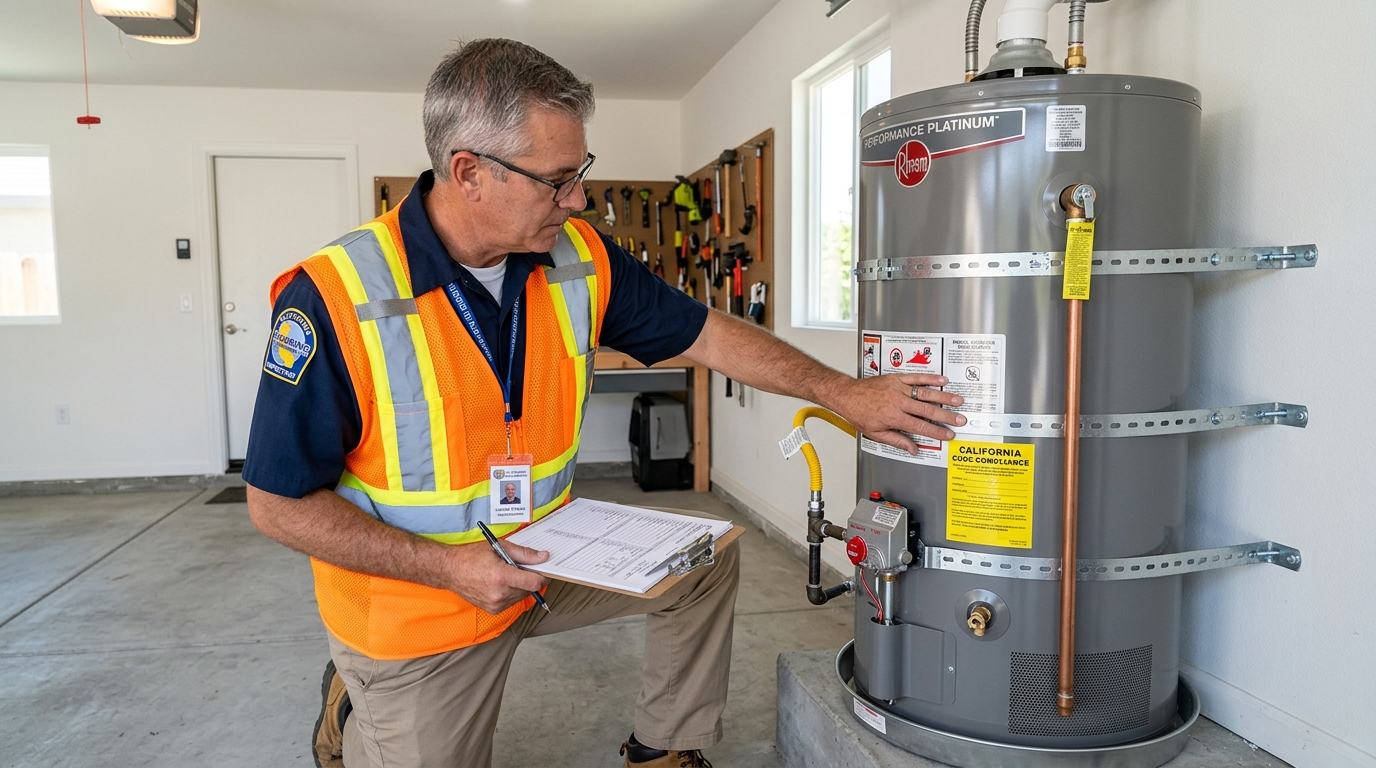
One of the most frequent questions Inland Empire homeowners ask when scheduling a water heater replacement is: "Do I really need a municipal building permit just to swap out an old, leaking water heater with a new one in the exact same spot?" Under California state law and local municipal ordinances in Colton, CA (92324), the answer is an unequivocal yes.
While some unlicensed handymen may offer to skip the permit to shave a few dollars off their quote, cutting corners on water heater permitting exposes homeowners to severe safety hazards, voided equipment warranties, and denied homeowner insurance claims in the event of an earthquake or flood.
In this detailed guide, the licensed plumbing specialists at Colton Water Heater Experts break down the legal requirements for water heater permits in the City of Colton, what city inspectors examine during a site visit, how Title 24 energy mandates apply, and how our turnkey installation service handles the entire permit process on your behalf.
The Legal Framework: California Plumbing Code & City of Colton Mandates
Under Section 301.2 of the California Plumbing Code (CPC, Title 24, Part 5) and the City of Colton Municipal Code, any construction, alteration, repair, or replacement of plumbing equipment requires a permit issued by the City of Colton Development Services Department (Building & Safety Division) located at 659 N. La Cadena Drive.
This law is not simply a municipal revenue measure; it is fundamentally a life-safety protocol. A residential water heater is a pressurized mechanical vessel containing between 40 and 75 gallons of scalding water heated up to 140°F, connected to either combustible natural gas lines under pressure or high-voltage 240-volt electrical circuits.
An improper, unpermitted installation can trigger catastrophic hazards:
- Carbon Monoxide Poisoning: A poorly configured exhaust flue can spill deadly, odorless carbon monoxide gas back down into your living areas while your family sleeps.
- Gas Line Explosions: Reusing brittle, degraded flexible gas lines or failing to install an approved gas sediment trap (drip leg) can cause gas leaks that ignite.
- Earthquake Fire Catastrophes: During a seismic event, an unstrapped water heater can topple, snapping the rigid gas line and igniting structural framing.
- Boiler Explosions: An uninspected Temperature & Pressure (T&P) relief valve that is plugged, capped, or improperly routed can cause a water heater cylinder to rupture with the explosive force of dynamic pressure.
The 4 Critical Safety Checkpoints City Inspectors Examine
When a licensed building inspector from the City of Colton inspects your newly installed water heater, they verify strict adherence to four primary life-safety standards:
1. California Seismic Double-Strapping Mandate
Because Colton is situated in close geographic proximity to the active San Jacinto Fault Zone and the nearby San Andreas Fault, seismic bracing is enforced with zero tolerance. Under California Health and Safety Code Section 19211:
- Water heaters must be secured with a minimum of two heavy-gauge galvanized steel seismic straps.
- The top strap must be positioned in the upper third of the cylinder (at least 4 inches down from the top), and the lower strap must be placed in the lower third (at least 4 inches above the burner access controls).
- Each strap must be securely anchored into solid 2x4 structural wall framing studs using minimum 3-inch long by 1/4-inch diameter lag screws and heavy flat washers. Drywall anchors or masonry anchors into hollow brick are strictly prohibited.
2. Thermal Expansion Tank Compliance
When the City of Colton water department or regional utility installs a backflow preventer or check valve at your water meter, or if your home features a Pressure Reducing Valve (PRV), your plumbing system becomes a "closed system."
As cold water is heated from 55°F to 130°F inside a sealed tank, it expands in volume by approximately 2% to 3%. In an open system, this extra volume pushes back into the city water main. In a closed system, that expanding water has nowhere to go, creating intense hydraulic pressure spikes exceeding 120 to 150 PSI inside your household pipes.
To pass Colton building inspection, a properly sized ASME-rated thermal expansion tank must be installed on the cold water inlet line above the heater, pre-charged with air pressure to match your home's incoming static street pressure.
3. Combustion Air Intake & Type-B Flue Venting
For natural gas water heaters, proper drafting is essential for life safety. Inspectors verify:
- The exhaust vent pipe maintains a continuous upward pitch of at least 1/4 inch per foot of horizontal run toward the roof termination.
- The flue utilizes approved double-wall Type-B metal pipe wherever it penetrates ceilings, attics, and roof decks, maintaining a mandatory 1-inch clearance from combustible wood framing.
- If the water heater is installed inside an enclosed interior closet or utility room, the space must feature high and low combustion air grilles to supply sufficient oxygen to the burner.
4. Temperature & Pressure (T&P) Relief Valve Discharge Line
The T&P relief valve is your water heater's emergency safety release. City code requires that its discharge pipe:
- Must be constructed of rigid copper, galvanized steel, or approved CPVC (standard PVC or garden hose is illegal).
- Must run downhill continuously by gravity with zero upward traps or dips.
- Must terminate to the building exterior, pointing downward between 6 and 24 inches above finished ground level, or into an approved drain receptor with an indirect air gap.
The Hidden Risks of Unpermitted Water Heater Replacements
Homeowners tempted to skip the municipal permit to save time or avoid permit fees should consider the serious long-term financial consequences:
1. Denied Homeowners Insurance Claims
If an unpermitted water heater fails, ruptures, or ignites a structural fire, insurance adjusters routinely investigate whether the installation had a valid municipal permit and passed city safety inspection. If the work was done illegally without a permit, your insurance carrier has legal grounds to deny coverage for water restoration, ruined flooring, and structural rebuilds.
2. Escrow & Home Appraisal Complications
When selling your home in Colton, Grand Terrace, or Loma Linda, buyer home inspectors rigorously inspect water heaters for code violations and missing city permit stickers. Discovered unpermitted work often halts escrow, requires emergency retrofits at seller expense, or results in demands for price reductions.
3. Voided Manufacturer Equipment Warranties
Major water heater brands—including Bradford White, Rheem, Navien, and Rinnai—explicitly state in their warranty terms that equipment must be installed by a licensed contractor in full compliance with local municipal codes. A catastrophic failure on an unpermitted unit can lead to rejected warranty claims.
How Colton Water Heater Experts Manages the Permit Process for You
At Colton Water Heater Experts, we take the stress and paperwork off your shoulders. Partnering with fully licensed & insured local plumbing professionals, our complete water heater replacement service includes turnkey permit handling:
- We prepare and submit the necessary permit application documents to the City of Colton Building & Safety Division.
- We perform all installation work strictly to California Title 24 plumbing, electrical, and seismic standards.
- We install all required safety equipment—including double seismic straps, calibrated thermal expansion tanks, full-port brass drain valves, and code-compliant discharge lines.
- We coordinate the municipal building inspection schedule and ensure final approval sign-off.
If your water heater is showing warning signs of failure, leaking, or approaching 10 years of age, trust the local specialists who do the job right the first time. Explore our complete guide to recognizing water heater failure symptoms, check out our comparison of tank vs tankless systems for the Inland Empire, or call our team today at (909) 588-3482 to schedule a code-compliant installation.