
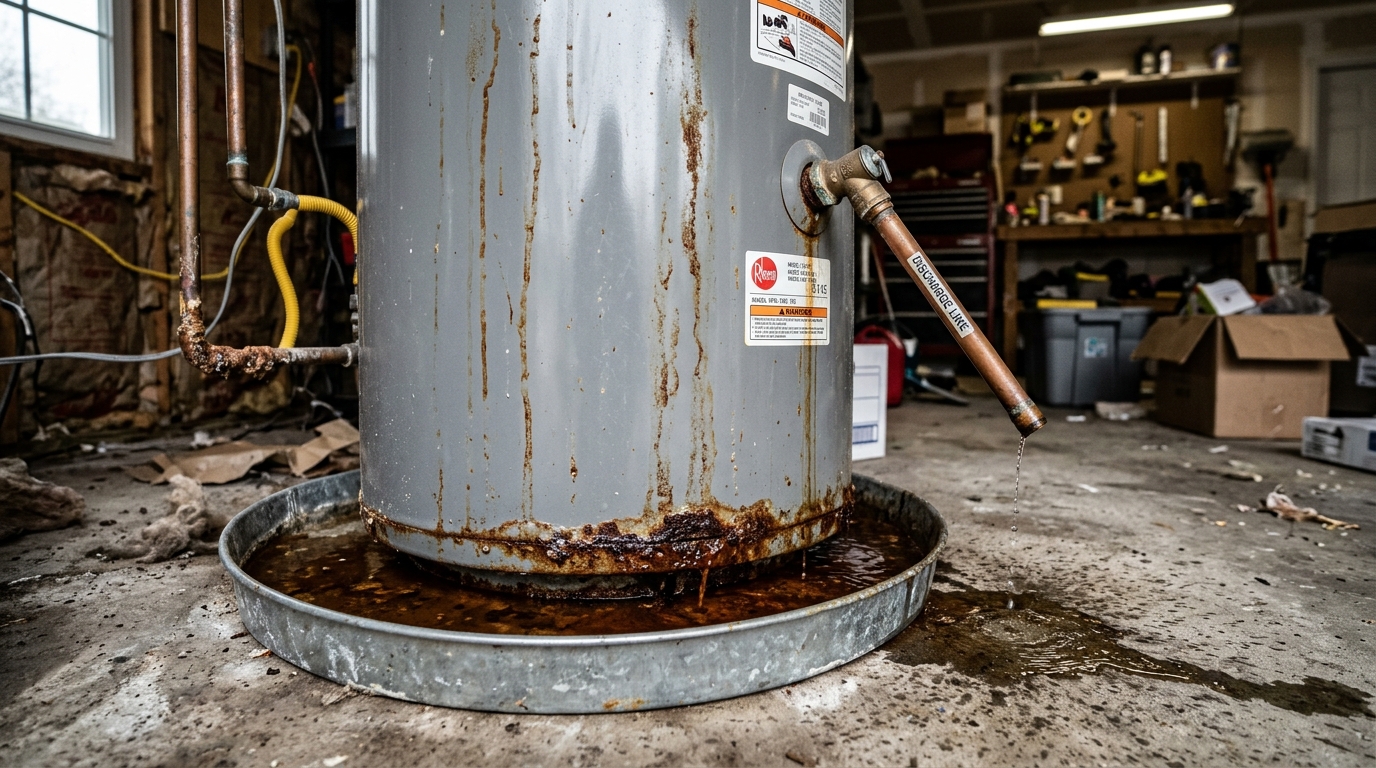
A catastrophic water heater failure rarely occurs completely without warning. In the overwhelming majority of cases, an aging or deteriorating water heater provides subtle mechanical and visual clues for weeks or months beforehand. Catching these early distress signals allows you to schedule a planned, affordable replacement on your own schedule—rather than dealing with an emergency middle-of-the-night flood, ruined drywall, and emergency restoration bills.
In Colton, CA (92324) and throughout the Inland Empire, where municipal tap water carries between 14 and 20+ grains per gallon of dissolved mineral hardness, water heaters operate under extreme physical strain.
Below, the California C-36 licensed plumbers at Colton Water Heater Experts detail the top 5 unmistakable warning signs that your water heater is nearing the end of its operational life, along with practical troubleshooting steps you can take today.
Warning Sign 1: Your Water Heater Has Reached Its 10th Birthday
Even high-end, premium water heaters are subjected to relentless physical wear: 24/7 hydraulic water pressure (typically 60 to 80 PSI), continuous thermal expansion and contraction cycles, and mineral-heavy water.
In the Inland Empire, the average design life of a traditional storage water heater is 8 to 12 years. While a well-maintained unit in soft water can occasionally reach 15 years, operating an unserviced water heater past age 10 in Colton is akin to driving on bald tires: sudden failure is only a matter of time.
How to Decode Your Water Heater's Age from the Serial Number
You do not need original purchase paperwork to determine your unit's age. Find the manufacturer rating sticker on the side of the tank and check the serial number:
- Bradford White: Uses a two-letter year and month code. The first letter is the year (e.g., "F" = 2009, "G" = 2010, "H" = 2011, "J" = 2012, "K" = 2013, "L" = 2014, "M" = 2015, etc.) and the second letter is the month ("A" = January through "M" = December, skipping "I").
- Rheem and Ruud: The serial number typically begins with a four-digit date code representing the week and year. For example, "0814" indicates the 8th week of 2014.
- A.O. Smith and State: Most serial numbers feature the year and week in the first four digits (e.g., "1524" indicates the 24th week of 2015).
If your water heater was manufactured more than 10 years ago, it is running on borrowed time. Scheduling a proactive safety inspection can help determine remaining cylinder health.
Warning Sign 2: Violent Rumbling, Banging, or "Popcorn" Kettling Sounds
When a water heater sounds like a pot of boiling water or makes loud thumping, popping noises that reverberate through floorboards, it is suffering from advanced sediment accumulation.
In Colton's mineral-dense groundwater basin, calcium carbonate and magnesium precipitate out of solution and settle onto the concave bottom head of the cylinder. Over several years, this mineral sediment compacts into a rock-hard layer 2 to 6 inches thick:
- Small volumes of water seep beneath the calcified scale crust and contact the scorching-hot bottom steel floor.
- Unable to circulate into the larger tank, this trapped moisture flash-boils into high-pressure steam bubbles.
- The steam pocket violently bursts upward through the rock layer, creating a dynamic shockwave that slams against the tank walls.
This constant hydraulic pounding weakens welded tank seams and fractures the internal porcelain glass lining. While an annual pressurized maintenance flush can remove loose sediment early on, a tank that has been violently rumbling for months has likely suffered permanent metal fatigue.
Warning Sign 3: Rusty, Orange, or Metallic-Tasting Hot Water
If water from your cold taps runs crystal clear, but water from your hot taps runs with a reddish-brown, yellowish, or orange tint, the internal steel cylinder of your water heater is actively rusting away.
Is the Rust Coming from the Water Heater or the Pipes?
To isolate the source of rusty water, perform this simple test:
- Turn on your kitchen cold water faucet and fill a clear glass. If the cold water is rusty, the issue originates in municipal supply lines or aging galvanized household plumbing.
- If the cold water is crystal clear, drain 3 to 4 buckets of water directly from the water heater's bottom drain valve into clean white buckets.
- If the water from the heater drain runs dark and rusty even after several gallons, your internal sacrificial anode rod has completely dissolved, and corrosive minerals are eating the raw steel tank cylinder.
Once rust begins flaking from the internal steel walls, pinhole leaks will develop shortly thereafter. Tanks cannot be re-lined or patched; replacement is mandatory.
Warning Sign 4: Moisture, Weepage, or Mineral Trails Around the Tank Base
Never dismiss small puddles, dampness, or dried white chalky mineral residue (efflorescence) around the base of your water heater as "simple condensation."
A slow, intermittent weep is often the prelude to a catastrophic blowout:
- Check the Temperature & Pressure (T&P) Valve: If water is dripping from the discharge pipe on the side of the heater, the T&P valve is blowing off excess pressure or has failed due to mineral buildup.
- Check Top Flex Connectors: If water is pooling on the domed top jacket, dielectric nipples or flex lines have corroded. This is usually an affordable leak repair.
- Check Beneath the Jacket: If water is oozing out from beneath the outer metal skin or through the bottom burner access door, the internal pressurized vessel has cracked. Shut off the cold water intake immediately and call our emergency dispatch line.
Warning Sign 5: Diminishing Hot Water Volume & Temperature Fluctuation
Is your morning shower turning lukewarm after only 5 minutes? Are family members arguing over who gets to shower first because the hot water runs out so quickly?
Loss of hot water capacity indicates one of three distinct mechanical failures:
- Heavy Sediment Displacement: In a 50-gallon tank, 15 to 20 gallons of storage volume can be occupied entirely by compacted calcium sediment gravel, leaving only 30 gallons of actual heated water capacity.
- Burned-Out Lower Heating Element: In electric water heaters, a burned lower element leaves only the top third of the tank heated, exhausting hot water in just 2 to 3 minutes.
- Broken Cold Water Dip Tube: The dip tube directs incoming cold city water to the bottom of the tank so it can heat from the bottom up. In older units, brittle plastic dip tubes crack and break off near the top. Cold water mixes immediately with hot water exiting the top outlet, delivering lukewarm water throughout your home.
Take Action Before an Emergency Flood Occurs
If your water heater is exhibiting one or more of these critical warning signs, do not wait for a catastrophic flood to force your hand. The licensed technicians at Colton Water Heater Experts provide same-day diagnostic inspections, upfront flat-rate pricing, and turnkey replacements across Colton, Grand Terrace, Loma Linda, and Rialto.
Call our direct dispatch line today at (909) 588-3482 to speak with a technician and protect your home today.