
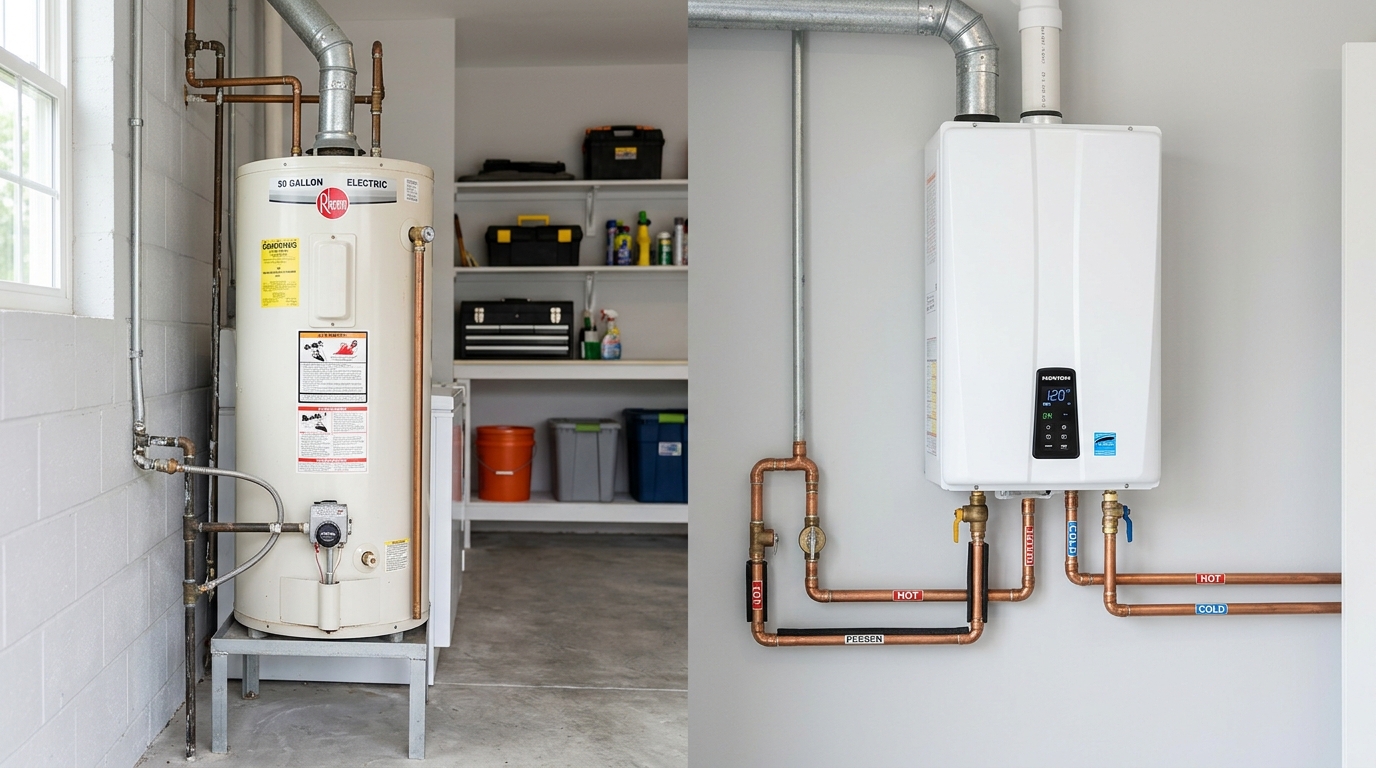
When your residential water heater approaches retirement, one of the most critical decisions you face is whether to replace it with a traditional storage tank model or upgrade to a modern, on-demand tankless water heater. In Colton, CA (92324) and throughout the greater Inland Empire, this decision involves distinct local factors—including regional groundwater mineral hardness (14 to 20+ GPG), gas meter sizing, garage configurations, and lucrative Southern California utility rebates.
Both technologies have distinct advantages and engineering trade-offs. Below, the California C-36 licensed plumbers at Colton Water Heater Experts provide a comprehensive, side-by-side comparison of costs, energy efficiency, maintenance requirements, and performance to help you choose the best system for your home and budget.
Side-by-Side Comparison: Tank vs. Tankless at a Glance
| Feature | Traditional Storage Tank | Condensing Tankless |
|---|---|---|
| Average Lifespan in Colton | 8 – 12 Years | 20+ Years |
| Energy Efficiency (UEF) | 0.60 – 0.68 (Standard) | 0.95 – 0.98 (Condensing) |
| Hot Water Delivery | Limited by Tank Size (40–50 Gal) | Endless / Continuous Flow |
| Floor Space Occupied | 9 – 16 Square Feet | Zero (Wall-Mounted) |
| Average Installed Cost | Request Tank Quote | Request Tankless Quote |
| Available Rebates | $0 – $100 | Up to $1,000 (SoCalGas) + 30% Tax Credit |
| Hard Water Sensitivity | Moderate (Bottom Sediment Crust) | High (Heat Exchanger Scaling) |
Traditional Storage Tank Water Heaters: Pros and Cons
Storage tank water heaters remain the most common choice across Colton, Grand Terrace, and Rialto due to their familiarity, simplicity, and lower initial replacement cost.
The Advantages of Storage Tanks
- Lower Initial Investment: Replacing a standard 40 or 50-gallon atmospheric gas water heater with a new unit is the most economical upfront option, generally ranging from $1,450 to $2,600 installed.
- Fits Existing Infrastructure: Because your home was built around a storage tank, existing 1/2-inch natural gas lines, water connections, and roof B-vent flues can usually be reused without major retrofitting.
- Operates During Power Outages: Standard atmospheric gas water heaters utilize mechanical millivolt thermopiles that require zero 120V household electricity, keeping hot water flowing even during Southern California electrical blackouts.
The Drawbacks of Storage Tanks
- Finite Hot Water Volume: Once the 40 or 50 gallons of stored hot water are exhausted by back-to-back showers or laundry, family members must wait 35 to 50 minutes for the tank to recover.
- Continuous Standby Energy Loss: Even when you are away at work or sleeping, the burner cycles on and off around the clock to keep standing water at 125°F–140°F, wasting energy.
- Vulnerability to Rupture: Holding 50 gallons of water continuously under pressure in a mineral-heavy environment inevitably leads to tank cylinder corrosion, creating a constant risk of catastrophic flooding.
Tankless (On-Demand) Water Heaters: Pros and Cons
Tankless water heaters do not store water. Instead, cold water flows through high-performance dual stainless steel heat exchangers that fire up instantly when a faucet opens, delivering hot water on demand.
The Advantages of Tankless Systems
- Endless, Continuous Hot Water: A properly sized tankless system (delivering 8.0 to 11.2 gallons per minute) can easily supply two to three hot showers and a dishwasher simultaneously without ever running out.
- 25% to 40% Lower Gas Consumption: By eliminating standby heat loss and achieving thermal efficiencies up to 96% to 98%, condensing tankless units drastically cut monthly natural gas bills.
- 20+ Year Design Life: Because water does not sit continuously inside a corrosive cylinder, high-end units from Navien and Rinnai routinely last more than two decades with annual maintenance.
- Reclaim Valuable Garage Floor Space: Wall-mounted tankless units take up zero floor space, freeing up room for vehicles, storage cabinets, or home workshops.
- Significant Utility Rebates: Qualifying ENERGY STAR models are eligible for Southern California Gas Company (SoCalGas) rebates of up to $1,000, along with federal Inflation Reduction Act tax credits of up to 30%.
Key Engineering Considerations for Tankless Retrofits
Transitioning to tankless in the Inland Empire requires specific plumbing modifications:
- Gas Line Sizing (BTU Capacity): While a standard tank requires only 36,000 to 40,000 BTUs of gas, a whole-home tankless unit demands between 160,000 and 199,000 BTUs. In older homes, this may require upgrading from a 1/2-inch to a 3/4-inch gas line from the meter.
- Dedicated Direct Venting: Modern condensing tankless units utilize cool PVC, CPVC, or polypropylene exhaust piping routed directly through an exterior wall or roof, replacing old metal chimneys.
- Electrical Outlet: Tankless units require a standard 120V electrical outlet nearby to power electronic ignition systems, digital circuit boards, and freeze-protection elements.
The Inland Empire Factor: Winter Groundwater Temperatures & Sizing
When sizing a tankless water heater, the incoming groundwater temperature determines the maximum flow rate (Gallons Per Minute or GPM). In Colton and the San Bernardino Valley:
- Summer Incoming Water Temperature: ~70°F (requires only a 50°F temperature rise to reach 120°F).
- Winter Incoming Water Temperature: ~50°F–55°F (requires a 65°F to 70°F temperature rise).
To ensure you can run two showers (approx. 2.5 GPM each) and a kitchen sink (1.5 GPM) during cold Inland Empire winter mornings, your system needs to deliver at least 6.5 to 8.0 GPM at a 65°F temperature rise. High-output condensing units like the Navien NPE-240A2 or Rinnai SENSEI RXP199i are specifically engineered to handle this load effortlessly.
The Hard Water Maintenance Factor
Colton's 14 to 20 GPG hard water impacts both systems, but in different ways:
- Storage Tanks: Sediment forms a thick crust at the base of the tank, causing kettling noise, burner overheating, and requiring an annual pressurized sediment flush.
- Tankless Units: Minerals crystalize inside the narrow heat exchanger passages. Tankless systems require an annual chemical descaling circulation flush with food-grade citric acid or vinegar via dedicated service isolation valves to maintain peak thermal efficiency and preserve your 15-year warranty.
The Verdict: Which System Should You Choose?
The right choice depends on your household's lifestyle, budget, and long-term homeownership plans:
- Choose a Traditional Storage Tank If: You want the lowest upfront replacement cost, have a smaller family (1 to 3 people) that rarely exhausts hot water, or plan to sell the home in the near future. A premium Bradford White or Rheem tank provides reliable, code-compliant performance.
- Choose a High-Efficiency Tankless System If: You have a busy household (4+ people) tired of running out of hot water, plan to remain in your home for 5 or more years, want to take advantage of $1,000+ utility rebates, and value reclaiming garage floor space.
Still undecided? The team at Colton Water Heater Experts provides free, in-home diagnostic consultations throughout Colton, Grand Terrace, Loma Linda, and Redlands. Call our licensed plumbers at (909) 588-3482 to evaluate your plumbing infrastructure and receive a transparent, flat-rate quote.