
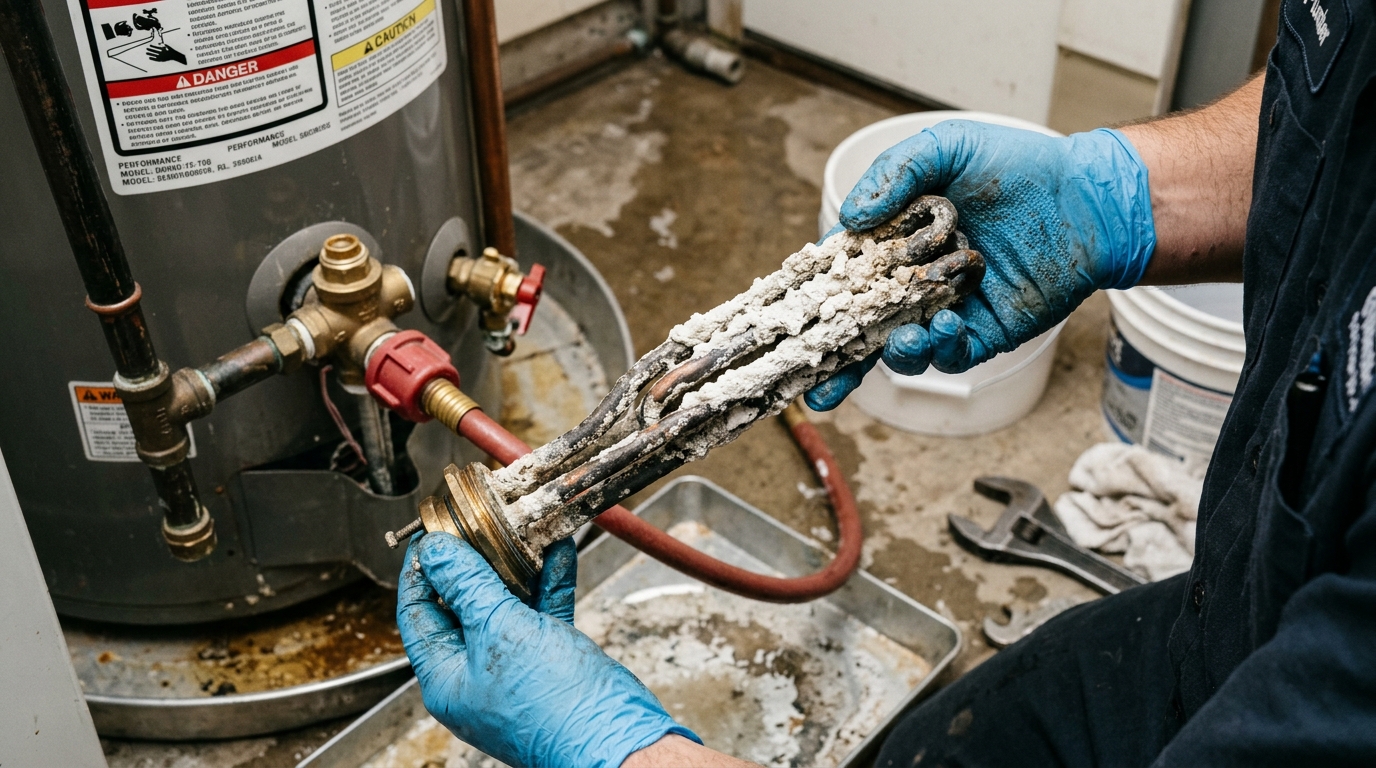
If you live in Colton, California (92324) or anywhere in the central San Bernardino Valley, your household plumbing system contends with one of the most mineral-dense municipal water supplies in the state. While Colton tap water is thoroughly tested and meets all federal and California drinking water standards, its heavy mineral chemistry is the number one cause of premature water heater failure across our region.
Homeowners moving to Colton from coastal Southern California or Northern California are often shocked when their water heater fails after only 5 or 6 years. In this comprehensive technical analysis, the licensed specialists at Colton Water Heater Experts explore the geological science behind Colton's hard water, explain the destructive physical mechanisms that occur inside your water heater, and provide actionable steps to double your equipment's operating lifespan.
The Hydrogeology of Colton Tap Water: Where Does It Come From?
Unlike communities in Los Angeles or Orange County that receive a high percentage of treated surface water imported from the Colorado River or the State Water Project, the City of Colton relies almost exclusively on deep groundwater production wells.
These municipal wells extract water from two primary subterranean aquifers: the Bunker Hill Artesian Basin and the Colton Subbasin. Rain and snowmelt filtering down from the granitic and limestone-rich San Bernardino Mountains slowly permeate deep alluvial gravels and rock strata.
During this subterranean journey, water dissolves substantial quantities of minerals, predominantly:
- Calcium Carbonate (CaCO₃): The primary building block of rock limestone and chalk.
- Magnesium Carbonate (MgCO₃): A dense alkaline mineral compound that contributes to severe mineral scaling.
- Dissolved Silica (SiO₂): A glass-like compound that hardens mineral scale into an impervious, concrete-like coating.
Measuring the Hardness: What Does 14 to 20 GPG Actually Mean?
Water hardness is scientifically quantified in Grains per Gallon (GPG) or parts per million (PPM / mg/L). One grain of water hardness is equivalent to approximately 17.1 mg/L of dissolved calcium carbonate.
The Water Quality Association (WQA) classifies water hardness according to the following scale:
| Classification | Hardness in GPG | Hardness in mg/L (PPM) |
|---|---|---|
| Soft Water | 0 – 3.5 GPG | 0 – 60 mg/L |
| Moderate Water | 3.5 – 7.0 GPG | 61 – 120 mg/L |
| Hard Water | 7.0 – 10.5 GPG | 121 – 180 mg/L |
| Colton Municipal Tap Water | 14.0 – 20.0+ GPG | 240 – 340+ mg/L |
Colton tap water sits deep inside the "Extremely Hard" category. In practical terms, for an average household using 250 gallons of hot water daily, over 100 to 140 pounds of dissolved limestone rock passes through your water heater every single year.
The 4 Destructive Mechanisms Inside Your Water Heater
When water is heated inside a storage tank or tankless heat exchanger, calcium carbonate undergoes a chemical shift: as water temperature rises past 125°F, calcium loses its solubility and crystalizes out of solution. This creates four distinct mechanical failure points:
1. Extreme Thermal Insulation of the Tank Bottom
In a gas water heater, burner flames fire directly against the curved steel bottom head of the cylinder. As calcium crystals precipitate, gravity pulls them down to form a dense sediment bed.
Mineral scale conducts heat roughly 30 times less efficiently than steel. A mere 1/4-inch layer of scale acts like an insulating firebrick between the burner and the water:
- The gas burner must fire up to 40% longer to transfer heat through the rock crust into the water.
- Bottom head steel temperatures soar well past 500°F (compared to normal 180°F operating conditions).
- This extreme heat cooks and fractures the internal porcelain glass lining, exposing raw steel to corrosive water and triggering sudden bottom leaks.
2. The "Kettling" Steam Explosion Phenomenon
Have you ever heard your water heater making popping, thumping, or banging sounds that resemble popcorn or a boiling tea kettle? That noise is the sound of water trapped beneath the calcified scale crust:
- Small volumes of water seep beneath the mineral bed and contact the scorching-hot steel floor.
- Unable to circulate, this trapped water flash-boils into superheated high-pressure steam.
- The steam bubble violently bursts upward through the rock layer, creating a dynamic shockwave that pounds against the tank walls.
- This continuous hydraulic hammering degrades welded tank seams until micro-fractures develop.
3. Electric Heating Element Encasement
In electric water heaters, the lower heating element sits directly in the zone of highest sediment concentration. As minerals accumulate, they encase the element in a solid rock sheath.
Because water can no longer circulate around the element to cool it, internal temperatures of the resistance wire soar past 1,000°F. Within a few weeks of heavy scaling, the element sheath blisters, ruptures, and causes a dead short, leaving your family with freezing cold water.
4. Accelerated Sacrificial Anode Rod Destruction
To prevent steel tanks from rusting, manufacturers suspend a sacrificial magnesium or aluminum-zinc rod in the tank. Highly mineralized, conductive water accelerates galvanic electrolysis.
In soft water, an anode rod lasts 5 to 7 years. In Colton's conductive 18 GPG groundwater, sacrificial anode rods are routinely chewed down to bare steel wire in just 24 to 36 months. Once the anode rod is fully sacrificed, corrosive minerals immediately begin attacking the steel cylinder walls, resulting in rapid pinhole leaks.
The Impact on Tankless Water Heaters
Many homeowners believe switching to a tankless water heater solves the hard water problem. In reality, hard water is even more dangerous for tankless units.
Tankless water heaters utilize compact copper or stainless steel heat exchanger tubes with narrow fluid pathways. When hard water is flash-heated at high flow rates, scale adheres directly to the inner coil walls:
- Scale narrows water passages, drastically reducing hot water flow and household pressure.
- The heat exchanger overheats, causing the computer control board to shut down the unit with error codes (e.g., Navien Error 110 or Rinnai Error 11).
- Major manufacturers explicitly state in their warranty documentation that heat exchanger failure caused by mineral scaling is excluded from warranty coverage.
How Colton Homeowners Can Protect Their Water Heaters
Living in Colton does not mean you are doomed to replace your water heater every 5 years. Taking a few proactive, professional steps can double or triple your system's operating lifespan:
- Schedule an Annual Pressurized Maintenance Flush: Our professional water heater flushing service uses pressurized agitation to break up and wash away calcium gravel before it bakes into rock.
- Inspect the Anode Rod Every 2 to 3 Years: Replacing a depleted sacrificial anode rod before it completely dissolves keeps the inner steel tank cylinder permanently protected against corrosion.
- Calibrate Thermostats to 120°F: Lowering water temperature from 140°F to 120°F significantly reduces the rate of mineral precipitation without sacrificing comfortable hot showers.
- Annual Tankless Descaling: For tankless systems, an annual recirculating flush with food-grade citric acid dissolves internal scale coils and maintains factory thermal efficiency.
- Consider Whole-House Water Conditioning: Installing an ion-exchange water softener or template-assisted crystallization (TAC) anti-scale system neutralizes hardness minerals before they ever reach your water heater.
If your water heater is rumbling, producing discolored water, or approaching 8 to 10 years of age, call the local specialists at Colton Water Heater Experts at (909) 588-3482 for a comprehensive safety inspection and maintenance flush today.